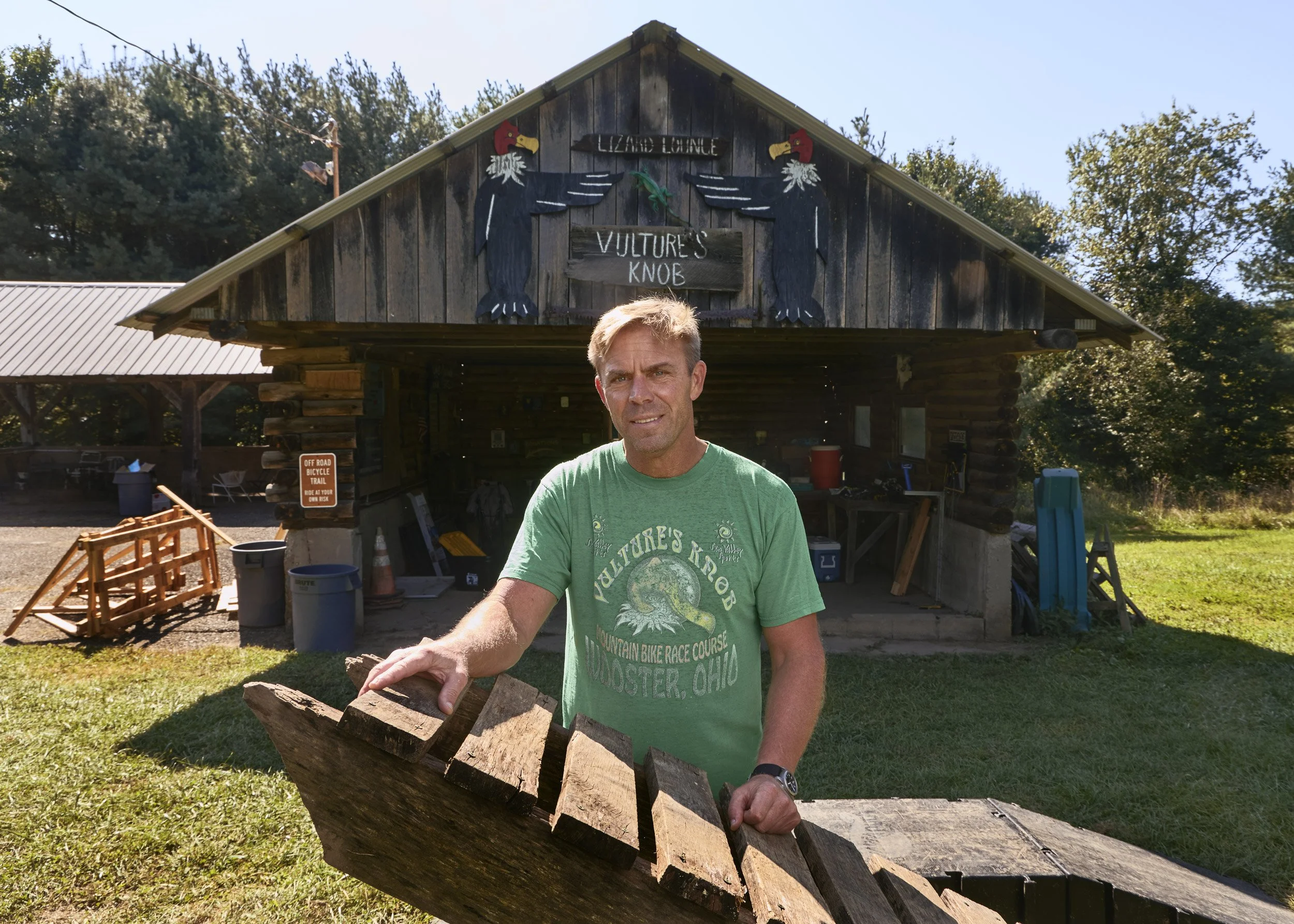
Paul Kovalcik
Vultures Knob, Wooster OH
August 2026
You can conquer the knobs and you can pretty much ride anywhere. Paul Kovalcik said it almost as an aside, near the end of a long conversation that had already covered a turtle, a ravine, and a night race with a mountain bike legend. But he's one of the few VK people who's actually tested the claim. He raced here in '98, then left, and moved to Maryland for about ten years.
He's come back and now on the east side of Cleveland, not far from where he grew up riding, but far enough from VK that he doesn't get down much anymore. Life does what life does. Kids, work, a schedule that doesn't leave room for an hour-plus drive just to ride. There's a closer trail near Canal Reservation now, almost across the street from his office, and most weeks that's the ride: duck out right after work, get a few laps in before the light goes, head home. Not racing anymore, but in it to stay fit.
But VK is where it started, really, Paul had been racing bikes since the early '90s, but nothing like this. He first rode here in 1997 and was racing by '98, and the way he describes it, it wasn't just another trail in the rotation. "This was kind of like a coming of age of biking here at this place," he said. "It was a different animal than anything else I did."
Part of what made it different was the whole culture around it. Mark Condry ran the races back then, and he ran them outside of traditional start times. No early starts, no national license required, no fee to some governing body. "The guy would put on a race and it wouldn't start until like five, six o'clock at night," Paul said. "So it was a Saturday, I didn't have to get up at the crack of dawn just to go ride my bike. I could do stuff around the house and then come down, have a relaxing day, then come down here and do my race." You could just show up and hang out. ”It was a good vibe," he said, and said it again, like it needed repeating. It was that low-key, come-as-you-are racing scene he gravitated toward, old school before the label. Somewhere in there, around 2001 or '02, Gary Fisher himself showed up for a night race, riding a prototype 29er. Everybody wanted a photo standing next to him, this being well before the era of the selfie.
Vulture’s Knob left Paul with one of a kind stories. One of them starts with a plastic turtle. They used to scatter little trinkets out on the course during races, and if you grabbed one and didn't place, you could still trade it in for a prize at the end. Paul was having a rough race, but he looked down, and there it was, a plastic turtle lying in the dirt. He picked it up, carried it to the finish, and when they called out for whoever had it, Paul walked up to claim his prize. Inside a rubber maid tube was a real snapping turtle, full-grown and unimpressed, Paul didn't flinch. He's a biologist by training, so he just reached down, picked it up, and held it up for everybody to see. "I wish somebody had a picture of that still," he said. "That would have been a pretty cool shot."
The biology wasn't incidental to the story, it's the through line of his whole life since. Back then he was doing field work, fish sampling, water quality testing, which made picking up the snapping turtle make a bit more sense. These days he's traded fieldwork for infrastructure, working stormwater and sewer maintenance for the regional sewer district, and in one of those coincidences that only shows up once you've been paying attention long enough, he turns out to be connected to another thread of Portraits of Adventure (POA). He spent time on the early planning for the Gorge Dam removal project on the Cuyahoga, the same one POA has been separately documenting, working with the Army Corps of Engineers and local partners to get it from an idea to a real concept before handing it off. He still lives about a mile from the site. He knows Ben, one of the people on for that project.
Not every memory from out here was a good one in the moment. There's a gully on Trash Hill, right where the trail climbs, and Paul went off the edge of it once, late in a race, legs gone, balance gone with them. He went down into the ravine and came up tangled, a length of garden hose wrapped around his ankle, fighting to climb back out of a trail-side dump that had been sitting there since long before anybody was racing bikes over it. Funny in hindsight, the trail giving you exactly what its name promised and then some.
Asked what he'd miss most about a place like this, Paul didn't talk about any single feature, he talked about how this style of trail is disappearing. "It's still sort of that old school single track trail," he said. "They're just not building that these days." Everything new is flow and jumps and tabletops, built for speed and spectacle. VK was never that. It was hand-dug and difficult on purpose, and people his age, people who'd been riding since the '90s, were going to feel that loss just as much as the camaraderie that came with. He didn't dwell on it, but the losing was real to him.
Looking back on those years, he doesn't frame it as just a bike trail. "It was just a time of my life where I was doing a lot of, you know, finishing grad school, trying to get my career going, mountain biking, having a really good time doing that," he said. "A lot of things happening, so it brings back a lot of things." A lot of personal growth. A lot of biking growth, as he put it, like the two were bonded. VK was the backdrop to becoming who he was going to be, a biologist, a father, a guy who moved away only to find himself back again for one last ride.
More from Vultures Knob
Explore other Chapters